
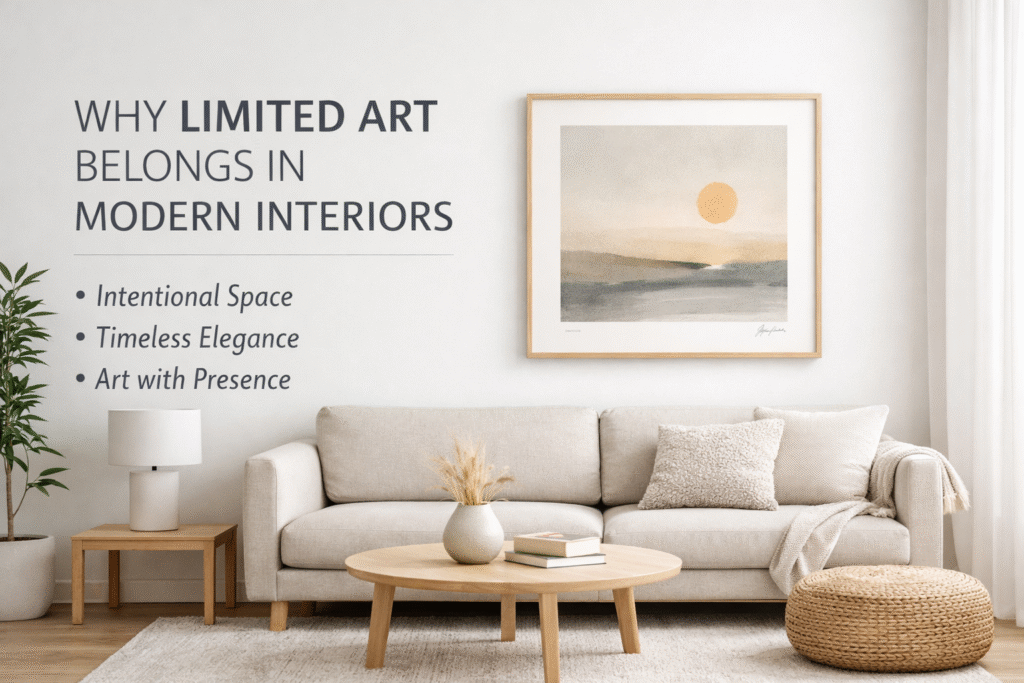
Why Limited Art belongs in modern interiors
Modern interiors are no longer about filling space.
They are about shaping experience, atmosphere, and how a room is felt rather than simply seen. Every element is chosen with greater care, and empty space is no longer treated as absence, but as part of the design itself.
As design has shifted toward clarity and restraint, limited art has become increasingly relevant. In homes defined by fewer objects and stronger intention, art is no longer decoration—it is presence. It carries weight, meaning, and responsibility within a space that allows little room for distraction.
This is why limited edition prints belong so naturally in modern interiors. Their restraint mirrors contemporary design values, their material honesty complements architectural simplicity, and their quiet authority allows them to coexist with space rather than compete for attention.
The evolution of the modern interior
Over the past decade, interior design has moved away from excess and toward intention. Spaces are lighter, quieter, and more deliberate. Furniture is reduced to essential forms. Materials are chosen for longevity rather than novelty.
In this environment, every object carries weight. What hangs on a wall is no longer background—it becomes a focal point.
A limited print, by definition, is made to occupy this role. It is not interchangeable. It is chosen.
Limited Art as presence, not decoration
In the past, art often functioned as décor—something to fill walls quickly or follow trends. Today, modern interiors demand more.
Limited art is valued because it:
-
Holds visual space without overwhelming it
-
Complements architecture rather than competing with it
-
Encourages reflection rather than distraction
A limited edition print gains power precisely because it is not everywhere. When fewer artworks are displayed, each one matters more.
One carefully chosen print can define the atmosphere of an entire room.
What makes a Limited Edition Print meaningful
A limited edition print is not simply a reproduction. It is a controlled body of work, produced with clear boundaries and intention.
Key characteristics include:
-
A defined edition size
-
Individual numbering
-
Artist involvement or authorization
A limited numbered print establishes trust between artist and collector. The number is not a fraction—it is a declaration of finitude.
For a detailed explanation of how editions are defined and why numbering matters, FineArtKlub’s
definitive guide to limited edition numbered prints explores these principles in depth.
Limitation is not scarcity for its own sake.
It is integrity.
Why Limited Prints work in Contemporary spaces
Modern interiors often rely on subtlety rather than statement. This is where limited prints excel.
Unlike mass-produced wall décor, fine-art prints:
-
Absorb light instead of reflecting it
-
Introduce texture without noise
-
Create intimacy rather than dominance
A limited print on paper interacts gently with its environment. It responds to light, framing, and space in a way that feels human rather than commercial.
This makes limited edition prints especially suited to living rooms, bedrooms, studios, and private workspaces.
The importance of Paper and Printing
Material quality is essential to the longevity of a limited edition print.
Archival pigment inks and cotton-based papers ensure that a print will age with dignity rather than degrade over time. These materials preserve tonal depth, texture, and color stability for decades.
FineArtKlub’s ultimate guide to giclée printing on Hahnemühle fine art paper explains why museum-grade papers are fundamental to the value of limited art.
In modern interiors—where every surface is noticed—material honesty matters.
Limitation as a design principle
What separates meaningful art from decoration is limitation.
A limited edition print introduces restraint into the creative process. It defines a finite body of work and commits the artist to that boundary. Once an edition ends, it remains closed.
This mirrors modern design philosophy itself. Just as designers limit furniture, colors, and objects, artists limit availability.
A limited numbered print reflects the same discipline that defines contemporary interiors: less, but better.
Living with Limited Art over time
Trend-driven décor often fades quickly. Limited art does not.
The value of a limited print reveals itself slowly:
-
Through repeated encounters
-
Through changing light and seasons
-
Through familiarity rather than novelty
A limited edition print becomes part of daily life. It does not demand attention—it rewards it.
This long-term relationship aligns perfectly with interiors designed for longevity rather than immediacy.
Emotional Architecture and Limited Art
Art plays a quiet but powerful role in shaping how a space feels.
A single limited edition print can soften a room, create calm, or introduce warmth. Its presence is subtle but persistent.
Institutions such as the Museum of Modern Art (MoMA) have long examined how art interacts with architecture and lived environments, reinforcing the idea that art shapes experience—not just walls.
https://www.moma.com
Limited art carries intention, and intention is felt.
Collecting Limited Prints with intention
Collecting today mirrors modern design itself. It favors patience over impulse and curation over accumulation.
For collectors seeking clarity, FineArtKlub’s
complete guide to fine art prints provides essential context around techniques, materials, and terminology.
Choosing a limited edition print is not about ownership alone. It is about alignment—between space, artwork, and values.
Quality, Scarcity, and Trust
Scarcity alone does not create value. A limited print must also be well made.
Edition size, print quality, paper choice, and transparency all contribute to trust. FineArtKlub explores this balance in
why limited edition quality and scarcity truly matter.
A carefully produced limited numbered print carries emotional and material integrity—qualities that endure long after trends pass.
The quiet return of the Limited Print
In an age of infinite digital images, the appeal of limited art has grown stronger, not weaker.
Collectors are returning to physical prints because they offer:
-
Tactility
-
Permanence
-
Relief from screens
A limited edition print exists fully in the physical world. It slows the gaze and restores stillness.
In modern interiors designed to counteract overstimulation, limited prints provide grounding.
Choosing Limited Art with intention
Modern interiors reward selectivity.
They ask fewer objects to do more work. Limited art belongs in these spaces because it shares the same values:
-
Restraint
-
Craftsmanship
-
Longevity
A limited edition print does not need to shout.
It simply needs space.
Choosing limited art with intention
Modern interiors ask for clarity.
They reward restraint and thoughtful choices made over time.
They benefit most from fewer elements that are selected with care.
This is where limited art belongs.
Limited edition prints align naturally with contemporary living because they support space rather than crowd it, and presence rather than excess. They allow a room to feel complete without feeling full.
Limited art offers:
-
Focus
A single artwork can anchor an entire room and quietly guide the eye without overwhelming the space. -
Balance
Limited prints work in harmony with light, scale, and proportion, reinforcing the architectural rhythm of modern interiors. -
Calm
They do not demand attention at first glance, but reward those who spend time with them. -
Material honesty
Paper and pigment feel natural and tactile, introducing texture and depth without relying on shine or visual noise. -
Permanence
Quality materials age slowly and gracefully, allowing the artwork to remain relevant as interiors evolve. -
Meaning
A limited print carries intention and authorship, rather than excess or repetition.
Choosing limited art is not about filling walls quickly.
It is about making decisions that hold up over time and continue to feel right long after trends have passed.
Modern interiors benefit when:
-
Walls are allowed to breathe
-
Objects have purpose rather than decoration
-
Empty space is treated as a design element
Limited edition prints fit this mindset naturally.
They are distinct without being dominant, and refined without feeling distant or untouchable.
Over time, the relationship deepens as the artwork becomes familiar and quietly integrates into daily life. Changing light, seasons, and routines reveal new details rather than diminishing interest.
This is where value truly emerges.
Not from novelty.
Not from speed.
But from consistency and presence.
Limited art encourages patience.
It slows the act of looking and invites repeated attention without fatigue.
It reminds us that art does not need scale to matter, repetition to feel important, or explanation to justify its place.
A limited edition print simply needs space — space to be seen, space to be lived with, and space to endure.

Author bio – Susanne
Susanne is co-founder of FineArtKlub and plays a central role in both the artistic and operational side of the platform.
As an artist herself, she brings a practical understanding of materials, print quality, and the small details that define a true fine art print. Her work is closely connected to the physical process behind each piece - paper selection, color accuracy, finishing, and the final presentation that collectors receive.
At FineArtKlub, Susanne is responsible for overseeing production, printing, and logistics. She works directly with each edition to ensure that the result matches the intended artistic expression - from the first test print to the final packaged artwork.
Her approach is precise and hands-on. Nothing is rushed. Every print is treated as an individual piece, not a mass-produced product.
Alongside her operational role, Susanne continues her own artistic practice, which informs her standards and attention to detail. She understands what it means to create something that should last - both visually and materially.
At the core of her work is a simple principle: if it is not something she would hang herself, it is not something that leaves the studio.