
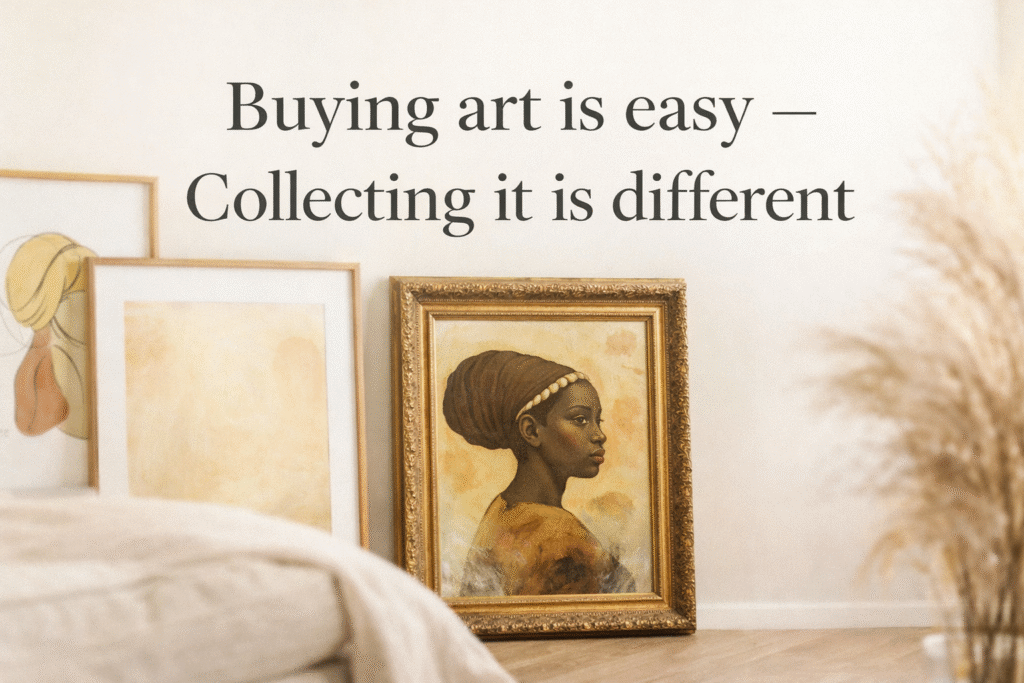
Fineartklub Magazine issue 001 – art collecting guide
There’s a quiet but important difference between buying art and actually living with it over time.
Most people don’t think about it in those terms, and honestly, I didn’t either for quite a long time. You see something, you feel something, and you buy it. It fits the space, it creates the right mood, and in that moment it feels like a good decision. There’s nothing wrong with that process. It’s intuitive, it’s immediate, and it makes sense.
But then something shifts.
Not suddenly, and not in a way that’s easy to point to, but slowly, almost without you noticing. The piece becomes part of the room in a very passive way. You stop looking at it. It’s still there, still technically “working,” but it no longer gives you anything new.
And that’s the part most people don’t expect.
It’s not that the artwork was bad. It’s that there wasn’t enough there to hold your attention over time.
That pattern is something I’ve come back to again and again, both in my own decisions and in conversations with others who feel the same thing but don’t quite have the words for it.
Why this isn’t really about taste
People often say they don’t understand art, or that they don’t have the eye for it. What they’re usually expressing is not a lack of interest, but a lack of trust in their own judgment. They feel uncertain about whether what they’re responding to is actually “good,” or whether it will still feel right months or years later.
And that uncertainty is completely understandable.
Most people are never taught how to look at anything in a structured way. Not art, not design, not even everyday objects. So they rely on instinct. They respond to color, to mood, to a quick emotional reaction. And again, there’s nothing wrong with that.
But instinct alone operates on the surface.
It doesn’t explain why something works, or why something holds. And without that understanding, it becomes very easy to choose something that feels right in the moment but doesn’t last.
Taste is not the problem.
The problem is the lack of structure behind the decision.
The kind of art that works fast — and fades just as fast
There’s a type of artwork that is designed, whether intentionally or not, to work immediately. It fills a space nicely, it matches the room, and it creates a certain atmosphere without asking anything from you. It’s easy to live with, and that’s part of its appeal.
But over time, it tends to disappear.
Not physically, of course, but in terms of attention. You stop noticing it. It becomes interchangeable, something that could be replaced without really changing the feeling of the room.
That’s usually a sign that the decision was made on the surface.
You responded to the image, but not to the structure behind it.
And without structure, there isn’t much to return to.
Stronger work behaves differently, even if the difference is subtle at first. It doesn’t try to impress you immediately, and it doesn’t rely on obvious effects. Instead, it gives you something that unfolds over time. You look at it once, and then again later, and it still feels coherent. It still feels resolved.
That’s where the difference starts to matter.
What collectors actually do differently
There’s a common assumption that collectors simply have better taste, that they’re naturally more sensitive to what works and what doesn’t. In reality, that’s not what separates them.
What separates them is how they approach the decision.
They don’t rush it.
They don’t rely entirely on their first reaction.
They take a moment to observe what is actually in front of them, and that observation is usually based on very simple questions. What am I really looking at? Where does my eye go first, and where does it move after that? What feels intentional, and what feels unresolved? Does the piece hold together as a whole, or does it drift in different directions?
These are not complicated questions, and they don’t require any formal training.
But they change the way you see.
Instead of reacting to the surface, you begin to notice the structure. And once you notice the structure, your decisions become more stable. You’re not just choosing something that looks good in the moment, but something that continues to make sense over time.
Why so much art ends up feeling replaceable
Most people have experienced this without necessarily putting it into words. You buy something, you like it, you hang it, and for a while it feels like a good addition to the space. But after some time, it starts to feel less specific. It could be replaced with something else, and the difference wouldn’t be that significant.
That feeling usually comes from the same place.
The decision was made quickly, based on a surface-level response. There wasn’t enough attention given to what actually holds the piece together, so there isn’t much left to engage with over time.
When that happens, the artwork loses its presence.
It’s still there, but it doesn’t actively contribute anything.
A small shift that changes everything
The good news is that this doesn’t require a complete change in how you think about art. It doesn’t require years of study or a deep theoretical understanding.
It just requires a slightly different way of looking.
Instead of starting with interpretation or emotion, you start with what is actually present. You notice the shapes, the light, the direction of the composition, the way the space is used. You pay attention to how your eye moves through the image, and whether that movement feels controlled or accidental.
That small shift is often enough to change the entire decision.
Because once you see what is actually there, it becomes much easier to judge whether it holds.
A simple method that slows the process down
In the first issue of the FineArtKlub magazine, I wrote down a very simple method that forces this shift. It’s not complicated, and it doesn’t take much time, but it does one important thing.
It slows you down.
Instead of reacting immediately, you take a few minutes to look properly. You start with facts rather than interpretation, and you describe what you’re seeing in concrete terms. If you can’t describe it clearly, it’s very difficult to judge it accurately.
From there, you follow the path of the eye. Where does it begin, where does it move, and where does it end? Does the composition guide you in a controlled way, or does it feel scattered?
This process doesn’t tell you what to like.
It simply gives you a clearer view of what’s actually there.
And that clarity changes the decision.
The pieces that stay feel different
When you apply this kind of attention, something becomes obvious quite quickly.
Most pieces don’t hold.
They rely on immediate impact, and once that impact fades, there isn’t much left.
But the ones that do hold feel different from the beginning. They don’t try too hard, and they don’t need to. There’s a sense of control in them, a feeling that every element is placed intentionally. Nothing feels random, and nothing feels excessive.
You don’t need to convince yourself you like them.
You don’t need to explain them to anyone else.
They feel resolved.
And over time, that matters much more than initial impact.
What luxury actually means in this context
There’s a misunderstanding that comes up often when people talk about art in relation to luxury. The assumption is that luxury means more. More color, more detail, more visual impact.
In practice, it’s usually the opposite.
Luxury tends to be quieter, more controlled, and more precise. It’s not about adding more elements, but about making sure that everything that is there serves a purpose. That’s why some pieces feel expensive even if you can’t immediately explain why, while others feel cheap despite trying very hard to impress.
The difference is in the level of control.
And that’s something you can learn to see.
The physical side that most people overlook
Even if you understand the image itself, there’s another layer that matters just as much.
Art is not just something you look at. It’s something that exists physically in a space.
The paper, the surface, the scale, the way the piece is framed — all of these elements affect how the work is experienced. They influence how light interacts with the image, how depth is perceived, and how the piece feels in relation to the room.
Most people don’t think about these things at all.
But over time, they make a significant difference.
Why paper is not a small detail
Paper is often treated as an afterthought, but in reality it’s one of the most important components of the work.
It affects how the image is held, how the blacks behave, how the surface interacts with light. A cheap print can look fine on a screen, but in real life it often feels flat and temporary. It doesn’t have the same presence.
Better materials don’t announce themselves immediately.
But you notice them over time.
And they hold.
Materials are really about time
If something is meant to stay in your space for years, it has to be built for that. Otherwise it will gradually lose something. Color fades, surfaces change, and the overall presence weakens.
Good materials are not just about how something looks on day one.
They’re about how it continues to look and feel over time.
That’s what makes them worth paying attention to.
From image to object
There’s also a shift that happens when you move from thinking about art as an image to thinking about it as an object.
An image can be copied endlessly. It has no defined boundaries.
An object, on the other hand, is specific.
It has an edition, a format, a material, and a system behind it. It exists in a particular way, and that gives it weight.
That’s what makes it feel real.
And that’s what people respond to, even if they don’t always articulate it.
Why this first issue exists
This is something I kept seeing repeatedly. People wanting something that felt more considered, more stable, and more meaningful, but not really knowing how to get there. There’s a lot of information out there, and a lot of opinions, but not much clarity.
So I wrote something I would have wanted earlier.
Something simple, direct, and actually usable.
Not a theory, but a way of looking that you can apply immediately.
What you’ll find inside Issue 001
The first issue of the FineArtKlub magazine is built around that idea.
It includes a simple method you can use to evaluate any artwork in a few minutes, a basic vocabulary that makes it easier to understand what you’re seeing, and a clear explanation of how editions and variants work without unnecessary complexity.
It also looks at what makes something feel resolved, how authenticity should be handled, and why materials like paper and framing are not secondary details but part of the work itself.
There’s no filler.
Just the parts that actually change how you see.
What happens when you use it
When you start applying this way of looking, a few things tend to happen.
You notice more, and you notice it faster. You become more selective, not because you’re trying to be, but because things either hold or they don’t. And perhaps most importantly, you stop second-guessing your decisions.
You don’t need to rely on external validation in the same way.
You can see for yourself.
If you’re curious in art collecting guide
If you want to explore this in a more structured way, you can read the first issue here:
👉 https://fineartklub.com/magazine-issue-001
Take your time with it.
There’s no need to rush through it.
One last thing
You don’t need to become a “collector.”
That’s not really the point.
The point is simply to see more clearly.
Because once you do that, your decisions change.
And once that shift happens, you don’t really go back.

Author bio – Susanne
Susanne is co-founder of FineArtKlub and plays a central role in both the artistic and operational side of the platform.
As an artist herself, she brings a practical understanding of materials, print quality, and the small details that define a true fine art print. Her work is closely connected to the physical process behind each piece - paper selection, color accuracy, finishing, and the final presentation that collectors receive.
At FineArtKlub, Susanne is responsible for overseeing production, printing, and logistics. She works directly with each edition to ensure that the result matches the intended artistic expression - from the first test print to the final packaged artwork.
Her approach is precise and hands-on. Nothing is rushed. Every print is treated as an individual piece, not a mass-produced product.
Alongside her operational role, Susanne continues her own artistic practice, which informs her standards and attention to detail. She understands what it means to create something that should last - both visually and materially.
At the core of her work is a simple principle: if it is not something she would hang herself, it is not something that leaves the studio.